Let’s be honest: buying a desk online is usually a gamble. You scroll through endless photos, hope the measurements are accurate, and pray it doesn't arrive as a pile of particle board that wobbles every time you type.
In short: a standing desk that lasts has a steady steel frame with enough lift capacity, a top sized to your room, solid wood rather than particle board, a quiet and smooth lift with memory presets, and working heights set to your body.
At My-Desk.Co, we see this cycle all the time. You buy a cheap desk, it lasts a year, it starts to peel or shake, and you’re back to square one.
If you are finally ready to invest in a workspace that actually works for you and stays that way, here is how to choose a custom standing desk that is worth your money.
1. The "Wobble Test" (Stability is Non-Negotiable)
The biggest complaint we hear about mass-produced standing desks? They sway. When you’re at your standing height, that "wobble" is distracting and frustrating.
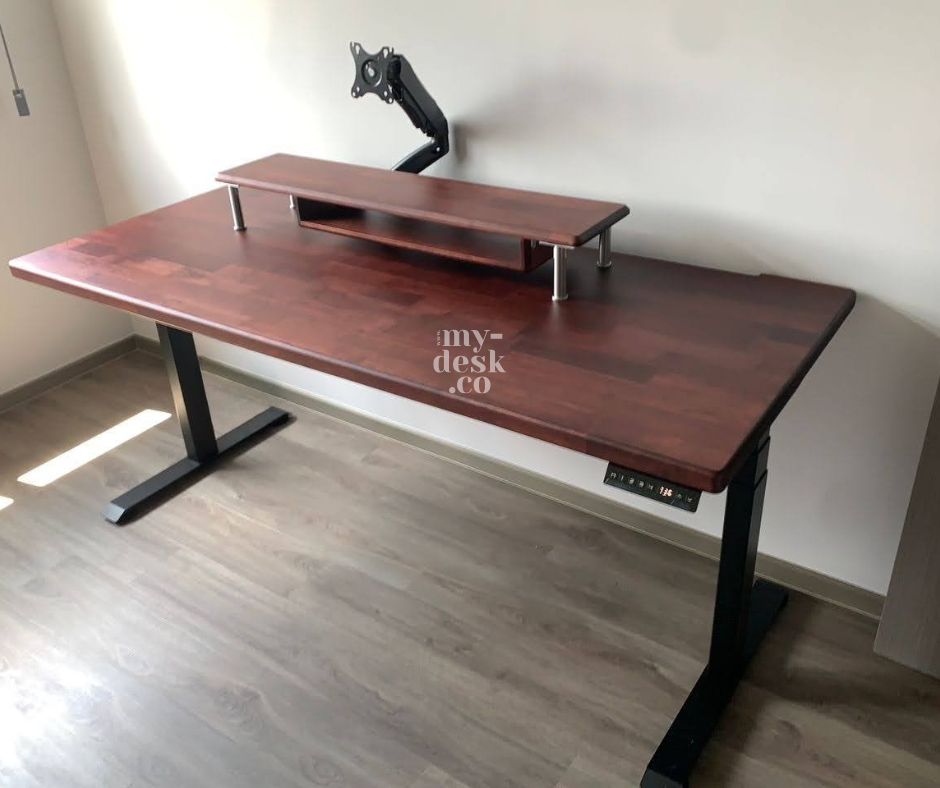
The Pro Tip: Look for a heavy-duty steel frame. A lighter frame is cheaper to ship, but it won’t hold up. A solid, grounded base is the difference between a productive day and a headache.
Check the lift capacity: it includes the top and everything on it. Our CX, KX and 3S frames lift up to 100 kg, and the three-leg 3X up to 150 kg. Compare the frames on our height-adjustable desks page.
2. Measure for Your Life, Not the Room
Most people buy a standard 120cm or 140cm desk because that’s what's available. But in Singapore, where space is a premium, "standard" doesn't always fit.
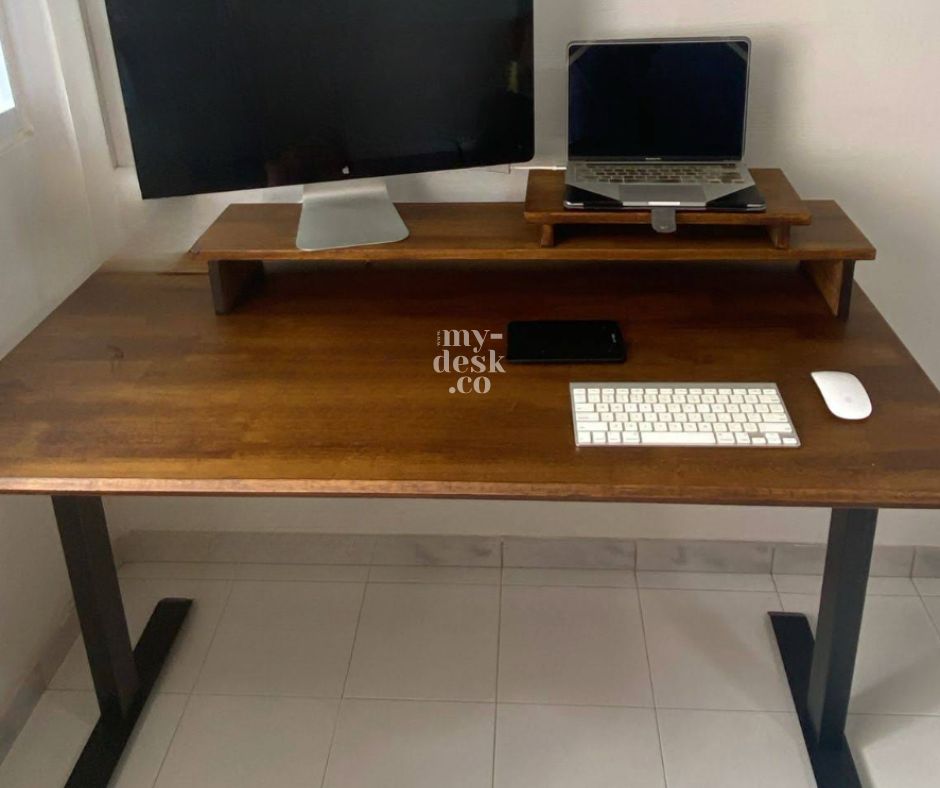
The Custom Advantage: Think about your "awkward" corners. Do you have a weird recess or a narrow nook? We build custom standing desks to the exact millimetre to maximise your footprint. Don't force your room to fit the furniture; get the furniture to fit the room.
3. Solid Wood vs. Everything Else
We build exclusively with solid wood for a reason. Particle board and veneers are meant for a season. Solid wood is meant for a decade.
The Longevity Factor: Solid wood can be refinished, it handles daily wear-and-tear better, and—let's be real—it just looks better. If you’re spending 8+ hours a day at your desk, you deserve a surface that feels premium, not plastic. Our comparison of solid wood and laminate goes into the detail.
4. Don't Ignore the Motor
Your standing desk is only as good as its lift mechanism.
What to check: Speed and noise. You don't want a desk that sounds like a lawnmower or takes a full minute to move up and down. A good lift system should be quiet, smooth, and have a reliable memory preset function so you can switch between sitting and standing instantly. Our guide to choosing an adjustable desk frame compares our frames.
5. Ergonomics Start with You
A standing desk isn't a "one size fits all" product. If the desk is too high or too low, you’ll end up with neck strain.
The Best Practice: When you go custom, you get to choose the depth and the finish. Ensure your setup allows your elbows to rest at a 90-degree angle whether you are sitting or standing. Our standing desk height guide shows the heights to aim for.
Tired of the "flat-pack fatigue"?
We don’t just ship boxes; we design setups. If you have a tricky corner or a specific vision for your home office, don't guess—let’s talk.
Send us your rough measurements on WhatsApp or through our custom project form, and let's design a workspace that you won't need to replace next year.