
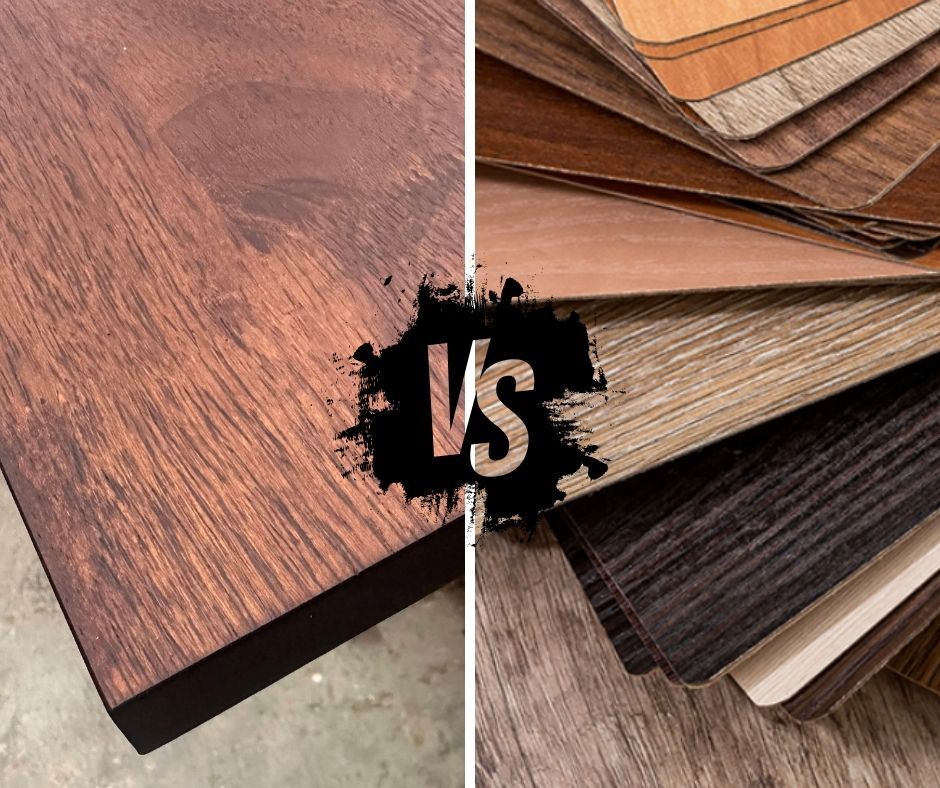
Solid wood is real timber all the way through; laminate is a printed surface glued onto MDF or particle board. For a desk you use every day, solid wood lasts longer, can be sanded and refinished, and can be made to any size. Laminate costs less upfront, but it tends to chip, swell or sag over time, especially in Singapore’s humidity. That’s why we build only in solid wood.
When you’re shopping for a desk, you’ll likely come across these two main material types. If you want a piece that truly lasts, here’s what the difference means in practice.
Solid wood vs laminate at a glance
| Solid wood | Laminate | |
|---|---|---|
| What it is | Real timber, full thickness | Printed layer on MDF or particle board |
| Look | Natural grain; no two alike | Printed wood pattern |
| Scratches | Can be sanded and refinished | Chips can’t be refinished |
| Humidity | Moves naturally; lacquer-finished | Core can swell if water gets in |
| Sizes | Made to your size | Mostly factory sizes |
| Upfront cost | Higher | Lower |
1. Durability: built to last or built to replace?
Solid wood desks, like the ones we craft at My-Desk.Co, are built for the long haul. They’re strong, heavy, and age beautifully with the right care. Small scratches can be sanded and refinished over time, so your desk keeps looking better, not worse.
Laminate or MDF desks, on the other hand, may look nice out of the box but tend to swell, chip, or sag over time, especially in Singapore’s humidity. The printed surface itself copes well with everyday wiping; the weak points are the edges and the board underneath.
2. Appearance and feel
There’s no substitute for the natural grain, warmth, and feel of real wood. Every solid wood desk we build is unique, because no two trees are the same. Laminate may try to mimic that look, but up close, the difference is clear.
3. Customisation
When you go with solid wood, you’re not limited to factory sizes or colours. Want a deeper tabletop? Extra drawers? A grommet cut-out or riser? You’ve got options. We cut each top to your size, shape and stain colour, and a top up to 244 × 122 cm can be made from one board. Square edges and corners are standard; eased, rounded or chamfered edges and rounded corners are optional upgrades, priced in your quote — the price estimator shows them. See solid wood tabletops for how we make them.
With laminate furniture, what you see is what you get.
4. Sustainability and repair
Solid wood is a natural, renewable resource, and it can be repaired and refinished, not thrown away. Our standard Hevea comes from rubber-tree plantations in Thailand and Malaysia, where the trees are used for timber once they have finished producing latex. If you care about sustainability, it’s a smarter long-term choice.
5. Cost vs value
Yes, solid wood may cost more upfront. But when you consider how long it lasts, and that it can be sanded and refinished rather than replaced, it’s often better value in the long run.
We also offer a price guarantee on comparable 100% solid wood desks; terms and conditions apply (see our FAQ).
What we build with
We use only 100% solid wood, never laminate or MDF. Our standard wood is Hevea, a durable hardwood. Paulownia is used for shelving, and premium woods such as walnut, oak, maple, ash, cherry and beech can be ordered. Every piece has a matte lacquer finish. See how Hevea compares with other woods, or see the full range of woods and finishes.
Final thoughts
If you’re investing in your workspace, go beyond the surface. Choose materials that support your workflow and reflect your values. Choose something that’s built for life, not just for now.
Related reading: What does solid wood really mean? · Solid wood vs plywood
Common questions
Do you make laminate or MDF desks?
No. We build only in 100% solid wood. Our standard is Hevea, a durable hardwood, finished in matte lacquer.
Can a scratched solid wood desk be fixed?
Yes. A wood touch-up pen works for small scratches, and a solid wood top can be sanded and refinished. We can refinish a top for a fee; send us a photo first.